OM STORIES
Meet Eric Cobb - living life to the fullest in Orange County, CA
OM Member, Eric Cobb, shares his story for the first time. His positive outlook on life and resilience in dealing with his diagnosis is truly inspirational. From racing BMX in Arizona to embracing long Colorado winters to coming face to face with a 10 ft seal in California, Eric is a living example of how to live life to the fullest no matter your circumstances.
OM Member, Eric Cobb, shares his story for the first time. His positive outlook on life and resilience in dealing with his diagnosis is truly inspirational. From racing BMX in Arizona to embracing long Colorado winters to coming face to face with a 10 ft seal in California, Eric is a living example of how to live life to the fullest no matter your circumstances.

My story with epilepsy begins when I was at school in the seventh grade.
I was reading a book in class, and went into a grand mal seizure while I was reading.
I was not born with it, or experienced it at a very young age, so I was completely lost.
I had my second seizure a year later, and that was when I went on medications, and began testing to see what was happening with me.
It took about a year and a multitude of tests to come to the conclusion that I am an epileptic.

I had moved to Colorado from Arizona a few months before I had my first seizure, and it goes without saying I was not a winter sports fan.
I grew up racing BMX, and riding jet skis due to the decent to incredibly hot weather that permitted me to do so.
I would spend a lot of time in my dad’s garage building old cars, and star gazing in the evenings after a good game of hide and seek with neighborhood kids after Christmas dinner.
I spent all of my time outside doing anything I wanted…
Let’s fast forward to my move to the mountains, and my complications.
I didn’t know how to feel after the seizure, or the cold place I had moved to where my bike sat in storage, and no local race track to ride on, and an oversized ice rink for a lake.
I became angry at times, sad at others due to both the illness and the place I was, that I shut down.
However when summer came around and I could see that there was more to the world than dirt and pavement, I began my love affair with Colorado, and how everything else on my shoulders no longer mattered.
There were giants made of solid rock for me to climb, raging angry rivers made from the melting snow atop the giant peeks that spread like veins across the land.
It was unlike anything I had ever seen before coming from a hot flat desert.
I put my winter time video games away (due to my distaste for snow), and took full advantage of the playground that lay before me.
Though all of the summer activities were magnificent, I still had hatred for the long cold winter that followed me all the way through high school.

I had later made friends that were really into snowboarding, and would taunt me a lot because I would always stay inside and sulk about the cold, and that because of my diagnosis I couldn’t go party at the bar because I couldn’t drink, and the flashing lights that I would feel alone.
Eventually I had enough, and I finally saw the playground that Colorado transformed into during the winter that I began to go snowboarding.
I was scared of falling off the lift, or hitting a tree, but I grew confident, and knew in myself that I didn’t want to be alone and hat nothing would stand in my way.
I felt complete…
I joined Outdoor Mindset in the summer of 2011 as a mentor excited about the opportunity to work with people going through the same struggles as I had.
I went several years without incident, but nothing lasts forever.
My medications were causing me to have liver failure, and I had to make a change, which caused me to have to spend a lot of time on myself.
After about a year I had a seizure on my way to work in December of 2011, and crashed my car through a small cinderblock wall, and wooden fence.
I picked myself up, and pulled the car into the garage to start the rebuild on it right away.
Again I wasn’t going to let anything stand in my way.
Now my seizure patterns were not even close to being as bad as most with maybe an episode every three years, due to my own faults not paying attention to my medication intake.
In December 2011, I had three seizures, one including the car accident, and it totally blindsided me.
I again was confused not knowing entirely what was happening; my new medication had negative effects on my moods, and would cause me to be very angry at times.
All of this confusion and anger mixed together caused me to draw the shades again.

It took about a month to get me on the right medication, and things began to look up.
No more wild mood swings, and I got back onto the path that I had been on for so many years.
I moved to California in October of 2012 and have been working with Outdoor Mindset to get things going in Orange County where I currently reside.
I had a seizure in early 2013, and continued with my positive outlook, and feel that I never even missed a step.
I try to get to the beach as often as I can to boogie board, and surf.
It has been awesome; I had a ten foot seal swim up to me one day!
I was scared for sure, but what an experience!
We just got done with a hike to the Hollywood sign in L.A. a few weeks ago.

I am thankful for all of the people in my life that pushed me (even the friends that taunted me) to experience life to the fullest, and not let anything get in my way, and that includes myself, and the way I handled things.
I am thankful to Outdoor Mindset for the mission to help us live for the best.
Even through my worst a few years ago, I remembered the motto and the commitments I made to the organization.
Without them I would still be playing video games…
Thank you,
Eric Cobb
Brad Rinehart on the Rock 'N' Roll Marathon
OM partner, Seize The World submitted this story for the OM Blog. Thank you, Seize the World for sharing and building awareness.
OM partner, Seize The World submitted this story for the OM Blog. Thank you, Seize the World for sharing and building awareness.
This month, Seize The World veteran and endurance athlete Brad Rinehart took some time to speak about a recent milestone: completing the Denver Rock ‘n’ Roll Marathon. In order to prepare, Brad worked closely with team coach (and STW Development Director) Charles Koller. Part of that training even involved an epic climb of the 14,036 foot Mt. Sherman in August, together with John Olson and
Colorado Climbers for Epilepsy Awareness
as well as
and Seize The World. Brad lives with his wife Tracy in Aurora, CO. Together, they are an amazing couple: outgoing and kind, but also undaunted by the challenges of epilepsy.
This interview is from a phone conversation with Brad last week about his recent adventures and accomplishments.
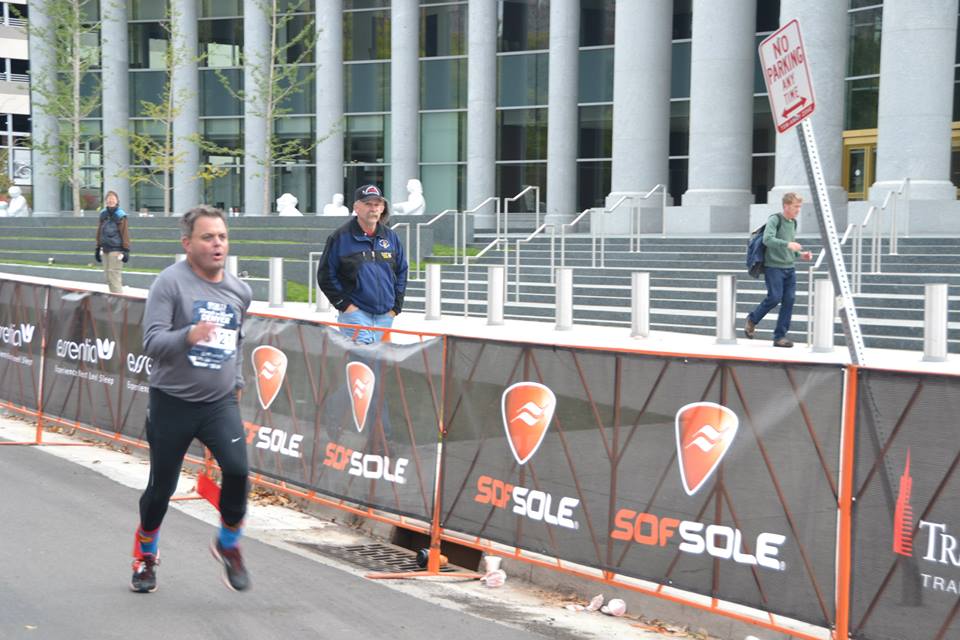
Brad Rinehart crossing the finish line of the Denver Rock ‘n’ Roll Marathon. Completing a marathon had been a long-term goal for Brad. He experienced three seizures on the morning of the race. (Photo by Ian McKittrick)
Why did you decide to run the Rock ‘n’ Roll Marathon?
It’s really easy, you do everything: you do a 5k, you a 10k, you kinda do them all, right? I guess as a runner you want to finish off your big long run eventually, you want to complete the cycle. I always said, eventually I want to do a full marathon. And I said ‘this is the perfect opportunity.”
With the Rock ‘n’ Roll Marathon in Denver you mean?
Yes, and I had so much support—I could not have made it through the whole marathon without my coach, Charles, I could not have made it through without his help. And doing it with Seize The World, they really helped me out. This was just the perfect opportunity to do the full marathon. I would never have done the full marathon by myself, you know what I mean? It was basically right in the back yard too.
What were some of the challenges you faced in preparing?
Well, I said to Charles, “Ok, I guess I am going to run the full marathon.” And that (26.1 miles) was just a big number. It was a big number in itself. And I just kept telling myself, “I’m going to do this.”
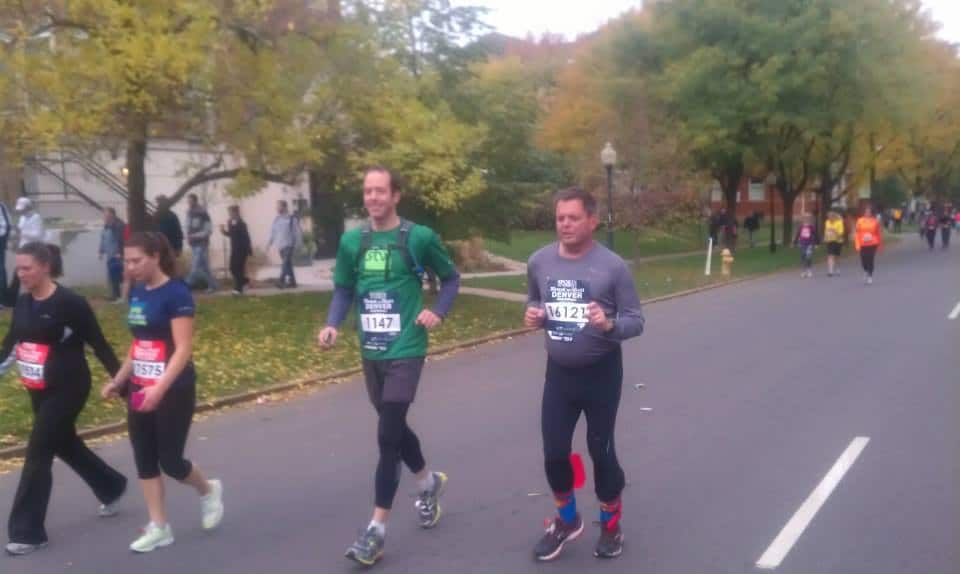
Brad Rinehart running with Charles Koller on 17th st. in the Rock ‘n’ Roll Marathon. Charles helped Brad with training and preparation for the marathon.
What was your training plan?
Just about every other day I would take my dog and then run a little bit and then walk a little bit. Each day I would try to build up my mileage. You know what it’s like: You have your bad days, you have to push up your mileage. I still kept thinking: “Am I going to make this thing?” There was always that.
Were there any moments when you thought to yourself, “what am I doing here?”
On race day, I had three seizures. (Brad had two seizures between 2a.m. and 5a.m. on race day, and a third at 6:00a.m. after meeting up with the team. The marathon began at 7:30 or so.) Then I just said, “Ok it’s just like a normal day.” I just knew that I wanted to finish, it was just kind of the “game on” kind of attitude though. And I wanted to finish. The other thing with the marathon was doing the hike up Mt. Sherman with John Olson and Colorado Climbers for Epilepsy and also the support of
. I don’t think I would have ever done that without them.
What was that climb like?
If you could imagine just about a trillion ball bearings or marbles, and if you tried to walk up. No matter where you walked, there is no way you could try to keep your balance. And here are these rocks that have been here for like trillions of years. (Brad is describing the infamous scree fields on Mt. Sherman’s West Slopes and SW Ridge. At one point, he scraped his knees during the hike before borrowing a set of trekking poles to help with balance on the descent).
I think I left a nice trail of blood on the side of the rock…you know, basically, I can laugh at it now, but you know by the time I came all the way down, you could see the parking lot, there was all these rocks you had to go across, but let me tell you, trying to walk across all these boulders, trying to go from one rock to the other, it’s not easy. It was an epic adventure.
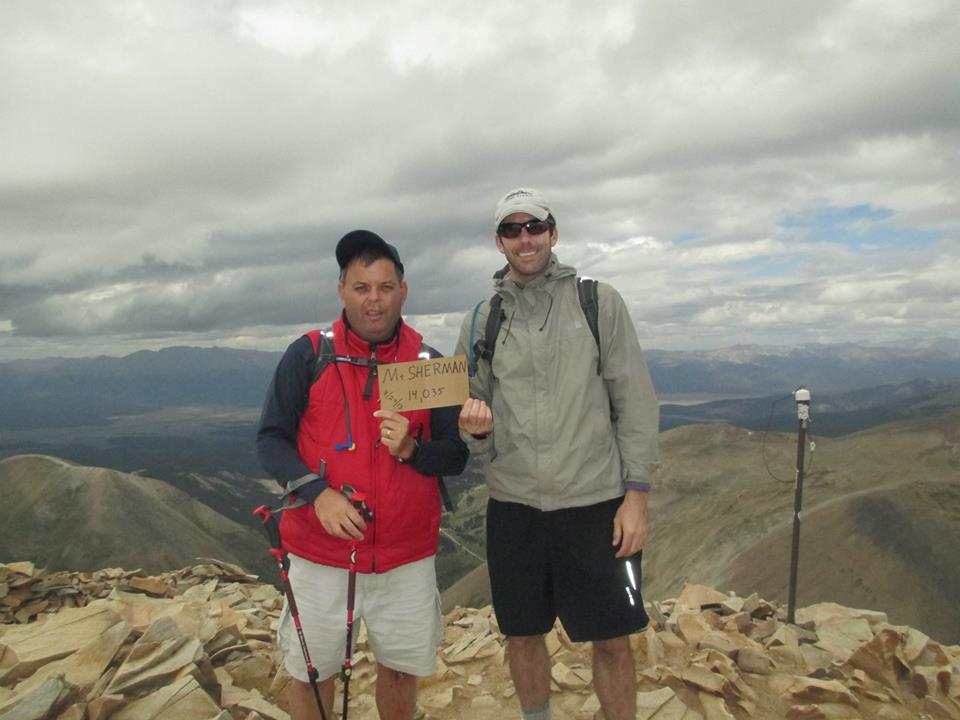
Brad Rinehart and Charles Koller atop 14,036ft. Mt. Sherman. The annual climb is organized by John Olson and Colorado Climbers for Epilepsy Awareness.
Did you think about the Mt. Sherman climb while you were running the marathon?
Climbing that, and knowing that I could do that, absolutely pushed me forward for the marathon. I was telling Charles, I was only hoping to make it in 6 hours, but Charles told me I finished in 5 hours and 56 minutes, I still just couldn’t believe I actually finished the thing in that amount of time.
How did your neurologist react to news of the marathon?
I took my medal to show my neurologist and she was really impressed by that.
What do you think about the
with Neuropace and the FDA?
I was really excited to see that thing getting approved, that is really a big deal, I think it is a really big notch. I was one of the first to start off with this [treatment].
Do you have any advice for people trying to find a safer or easier way through life with epilepsy?
No, but I guess you could say it this way: everybody has their bad days and everybody has their good days. One week I could have a perfect week, and the next day I could have a horrible seizure. You just don’t know. You just don’t know. I don’t think there is an answer.
Right now there is no cure for epilepsy. There isn’t. As much as I would like for there to be…if we did, you and I would both be billionaires, wouldn’t we? That’s just…I don’t…we don’t have the answer. Your friends are your safety valves, I guess.
And I know Tracy says a lot of the time when I have a breakthrough [seizure], I have to sleep. Sometimes my seizures just last about 30 seconds and that’s it. Sometimes I’ll just have confusion, and I’ll sit down and that’s the end of it. Everybody has a different trigger and a different cure for their stress. I run, because that’s what cures my stress.
Susan Mollohan isn’t Taking Parkinson’s Lying Down
Participating in clinical trials is one of many ways to stay active in the pursuit of a cure for neurological disorders, such as Parkinson’s disease. In this post, shared by The Michael J. Fox Foundation, Susan Mollohan shares how she combines her love for exercise and determination to participate in the pursuit of a cure for Parkinson’s disease by participating in clinical trials.
Participating in clinical trials is one of many ways to stay active in the pursuit of a cure for neurological disorders, such as Parkinson’s disease. In this post, shared by The Michael J. Fox Foundation, Susan Mollohan shares how she combines her love for exercise and determination to participate in the pursuit of a cure for Parkinson’s disease by participating in clinical trials. For more information about participating in clinical trials, visit
www.michaeljfox.org/clincialtrials
.

Susan Mollohan first noticed a tremor in her hand while at work as the Dean of Students at a high school in New Hampshire. After about four to six months of living with the tremor, the high school nurse, a friend of Susan's, suggested she see a neurologist. Soon after her diagnosis with Parkinson's disease (PD) in March 2009, Susan soon began taking advantage of opportunities to learn more about her diagnosis, and ultimately, do something about it.
At an educational seminar at Boston University about Parkinson's disease, Susan learned about an observational clinical trial studying the impact of exercise on PD progression that needed volunteers. "I was motivated to participate so that researchers could publish information about the benefits of exercise for other people with PD," says Susan, an avid skier and yoga devotee.
The study at Boston University lasted two years and required participants to come in for two visits each year. Participants were asked about their exercise routine, including type and frequency, and then underwent general physical assessments of their pace, balance, etc. "Participating in this trial gave me an improved outlook and attitude about my diagnosis," says Susan. "People need to take control of their health questions and get out there to find answers. We have to advocate for ourselves and not give in to the diagnosis." You can learn more about participating in clinical trials by visiting
www.michaeljfox.org/clinicaltrials
.

Since the completion of the study, Susan says she's willing to participate in another trial has registered as a volunteer on Fox Trial Finder,
’s online clinical trials matching tool. Fox Trial Finder (
) matches interested PD patients and control volunteers with the clinical trials that need them, and allows them to send direct anonymous messages to pursue enrollment. In doing so, Fox Trial Finder empowers the patient community to play an active a role in drug development.
Since its launch in 2011, over 24,000 people both with (76%) and without (24%) Parkinson’s disease have signed up on Fox Trial Finder
.

In addition to searching for new trials to participate in on Fox Trial Finder, Susan does yoga more now than before her diagnosis and has even written a book about the positive effects of yoga on her Parkinson's symptoms. Susan also fundraises for
and this year she and her husband Steven will participated for the fifth time in the annual New England Parkinson's Ride, a 50 mile bike ride through Maine benefitting The Michael J. Fox Foundation. Her team’s name is Suzy's Shakers.
And she's certainly shaking things up: Susan says her goal is to put a face to Parkinson's disease. Recalling an anatomy class she visited while working at the high school, she says, "Two girls happened to be giving a presentation about PD. They used a picture of a hunched over, elderly man. I told them, 'That's not the face of Parkinson's...this is.'"

You can be part of the answer to Parkinson's disease. Sign up today for
to learn about
ongoing clinical trials in your area and get involved in the pursuit of a cure.
Introducing...Your new Boulder OMbassador, Kat Drake
July 9th 2011 my world that I knew changed. I received a call from my Dr. saying that it’s confirmed. I had MS. I knew this was bad but didn’t really understand what it meant.

July 9th 2011 my world that I knew changed. I received a call from my Dr. saying that it’s confirmed. I had MS. I knew this was bad but didn’t really understand what it meant.
I lost my vision in my left eye 6 years prior but had a very physical life, full of hikes and doing what I loved, like hiking with dogs. Eventually my vision came back, and although it was scary, it was back. In May 2011, with various stresses in life, I lost my vision again. A couple weeks later, standing in wet grass and playing with dogs, I realized I had no feeling in my left foot and leg standing in the wet grass. I couldn’t feel it! I am a fighter and thought: odd…but nothing could be wrong. I was then convinced by my husband to see an eye Dr. who convinced me that I really needed to see a neurologist quickly.
In July, my life changed because I was dx with MS. How could this happen to me? I was healthy and had a great lifestyle. I hiked for a living. This could not be right!

On July 9
th
, I started a
new
journey, learning and living with MS. I didn’t want to give up the thought of hiking and doing what I loved. I searched for some support online and found Outdoor Mindset’s Meetup Group. I didn’t feel that sitting in a support group in a restaurant (eating food that I didn’t normally eat) was the way to go. I was so inspired talking to Kyle, the founder of Outdoor Mindset - a support group for people like me, who thrive on being outside. Outdoor Mindset gave me hope that I could continue to thrive and enjoy doing what I loved - being outside and pushing my limits.
Two years later, after not being able to walk more than a block, meeting and getting together with others who have neurological challenges, I am hiking and doing everything possible. My first Meetups with this group inspired me to continue to keep on trying to be outside. Nature is what gives me purpose. Outdoor Mindset is not only a support group of people who understand the challenges that I go through, but of others who have different challenges. I have laughed and cried over the challenges while we walk and MOVE, but Outdoor Mindset has given all of us hope.

I can’t say enough about Outdoor Mindset. Throughout my journey, it’s been so wonderful to meet others going through
similar challenges but are fighting to be outside and enjoy what nature has to offer for healing! I am not a fan of support groups that are inside. I only have so much energy with my chronic illness, and I want to spend it where I love the most, OUTSIDE and continuing my dreams of what I always wanted to do! Now with Outdoor Mindset I feel like I get the motivation to set new goals and challenges, all with people going through challenges of their own. Somehow it makes it easier and more motivating! Thank you Outdoor Mindset!!!!!!
Love you guys for what you have given to me!
Q: What are you most looking forward to as the Boulder OMbassador?

A: Meeting new people like myself. I am going through a lot of changes personally and miss hanging out with people who understand the challenges and motivations that I face. I feel as though I might not be able to do what I want to in the future so it important to me that I do “my bucket list” and continue to push myself.
Helping others. I feel like I am pretty positive in general. I would love to inspire others and help them on their journeys. I have been told I do this with my postings on Facebook and my journey of changing my diet to help my health and fight MS. I also believe in educating others about MS and the early possible signs. If I had caught it earlier I might have not lost so much from it, but on the positive note, MS has taught me a lot!
Submitted by Kat Drake
OM Member's Dream Becomes Reality
New OM Member, Marie Freed, lives in Minnesota and was diagnosed with MS in 2008. Despite the challenges, she and her husband have long dreamed of visiting the Grand Canyon. With the support of Outdoor Mindset and a 1-to-1 OM Connection, Marie and her husband were inspired to go on an adventure of a lifetime! Thank you, Marie and John for sharing your story and inspiring others!
New OM Member, Marie Freed, lives in Minnesota and was diagnosed with MS in 2008. Despite the challenges, she and her husband have long dreamed of visiting the Grand Canyon. With the support of Outdoor Mindset and a 1-to-1 OM Connection, Marie and her husband were inspired to go on an adventure of a lifetime! Thank you, Marie and John for sharing your story and inspiring others!

Here it is early September and after a lot of should we or shouldn’t we, together we voted for should! Grand Canyon, here we come. That said, we were warned that making hotel reservations on such short notice would be a challenge, especially for novice travelers like us. Planning details, making decisions and keeping in mind the unpredictability of MS was overwhelming resulting in John taking the lead, breaking each step down into manageable parts that I could participate in, easing the planning process stress I experience. With his patient persistence, IPhone, and internet savvy, our 8 day Grand Canyon vacation was becoming a reality.
Why the Grand Canyon and what took us so long to get there? Well, need we really answer the first part of that question - no because everyone, regardless of abilities MUST go to experience one of the “Seven Natural Wonders Of The World” and experience it themselves!
In 2008 I was diagnosed with RRMS, (Relapsing, Remitting Multiple Sclerosis) which was a life changer for us as a couple. Prior to the dx, we had lived an outdoorsy lifestyle, gardening galore, tailgating at County Parks, walking the dogs, made a living outdoors. In the Minnesota winters we enjoyed show shoeing, sledding, skating, shoveling, snow blowing, making snowmen, hiking at State Parks and hot tubbing outdoors. We also loved renovating homes and had done that with several homes so we were physically active people and we relied on our physical ability, in part to make a living. That also meant we were always too busy for a trip, or the current project was more important so we’d wait till we retired. Everything changed with the uncertainty that is an “in your face” reality with MS.
Our goals, ambitions, priorities changed dramatically during that first year living with RRMS. Health and wellness became our priority. How we used our time, energy and finances began to come in line with our new priorities and one of those priorities was to TRAVEL while it was still possible to do so safely, comfortably and financially feasible. We always talked about going to the Grand Canyon. Friends returning from their trips came back with thrill and awe in their faces. But fear remained within us, how would we manage MS so far from the comforts and routine of home? It was more than fear, terror is more accurate. Being away from my support network was terrifying, truly.
That terror eased a bit when I found Outdoor Mindset a few months ago. I loved the mission to get people of all abilities back in touch with the outdoors, to experience the wonders of nature, even if it’s as simple as feeling the sun on your face or the breeze on your skin. I shared the OM website with John and we both kind of had a “wow, really” moment, rapidly followed by a “hey, maybe” raised eyebrow look, to a full on “go for it” high five finally. I secretly contacted OM, was immediately matched with another member who shared our interest in a Grand Canyon trip and had resources to share. I really needed to find a level of self confidence to be fully on board with the trip and reading about people’s outdoor adventures inspired me to fight the fear and participate in making it happen. And it did!
September 21, 2013 we departed from Minneapolis International Airport, arriving in Las Vegas early morning. Stepping off the plane in Vegas really felt like we were in another world beginning our outdoor adventure. The change in vegetation and dry desert conditions are stunning and bewildering, so vast and sparse. Looking at the map while on the road, rather than in a recliner back in Minnesota, the environment commanded our attention. From Vegas, we decided to live on the edge and took a detour to Zion National Park in southwest Utah. A friend of John’s had said “ So you’re going to the Grand Canyon, that five minute wonder, that big hole in the ground people look at for five minutes and move on.” Surely, he would rethink his response when faced with such beauty, ruggedness and be at a complete loss for words, as we were when entering Zion National Park. If Zion National park with it’s fantastic, luscious rust colored peaks and sharp unforgiving cliffs, was our first taste of that so called five minute wonder, we couldn’t imagine what awaited us at the Grand Canyon. As an energy conservation strategy, John got us on the park trolley tour which helped me manage the heat. I go to jelly in the heat, my body, my brain, it all just slowly comes to a halt. Leaving Zion was difficult but as an unplanned detour, we had to get back on the road to our next stop, Jacobs Lake Arizona in the Kaibab National Forest 40 miles north of the Grand Canyon - North Rim.
September 22, 2013 we were so excited to get to the Grand Canyon, we didn’t even stop for coffee. Thought we’d get some on the way, ha ha ha. Make sure to get your coffee and fill your gas tank at the Jacob Lake Inn before you take off for the canyon. The terrain in this part of Arizona felt more like home, massive pines, towering aspens and beautiful grassy plateaus made the drive relaxing. The park ranger at the entrance helped with the access pass application, issued the pass and we were in the Grand Canyon National Park! With the actual canyon miles ahead, the roads got more windy, tree lines dominated by pines, we got a glimpse of the canyon. The Grand Canon Lodge - North Rim is a huge, beautiful log and stone structure with dining room, lecture hall and large sunroom overlooking the canyon with huge stone terraces accessible from either side of the sunroom. The structure was updated to include two chair lifts for accessibility. Attached to the lodge are a deli, saloon/coffee bar and gift shop. Our log cabin had all that we needed, comfy bed, toasty warm comforter, modern bathroom and a heater but we slept with the windows open despite the dip in temperature mid 30’s.
The beautiful vast and rugged view of the Canyon is so awesome that to process some of it I have to break it down. Looking at the animals that call the canyon home and the plants that grow - that would be quite a list. Our short stay was filled with education, hiking paths, sitting on the terraces with coffee in the morning sunrise, with a glass of wine for sunset and enjoying the fabulous menu and service of the dinning room. I have to say the intimate setting and its rugged beauty undoubtedly leaves me speechless, but I am so grateful to be here, experiencing this with the women I love! I took over 100 photos at the north rim, like a fanatic, or more so there is something about being there with someone you love that you can’t capture on film or express in this writing. With a full day of outdoor adventure in a high altitude, meeting new people from all over the world and processing this experience, we were tired and slept the best we had since leaving home.
September 23, 2013 was cool and breezy. A good travel day to drive the 5+ hours to the South Rim. If I could only fly like those California Condors it would’ve been a quick 10 mile trip across the canyon to the south rim. Along the way we entered the Navajo Reservation crossing over the Little Colorado River Gorge on the historic bridge. Looking down into that deep red rock river gorge, that river did not look so little to me. Navajo artisans had booths set up selling beautiful handmade crafts and jewelry.
Our first stop on the South Rim was Desert View, the site of the Watchtower, designed by Mary Colter and built in 1932. Several of Ms. Colter's buildings are still standing. Pulling into Desert View, the south east canyon entrance's main stay, offers park information, gift shops, acres of hiking among an unfamiliar blooming desert landscape that immediately made us realize we had not thought to bring an Arizona plant identification guide. Just beyond the tower, the canyon is revealed, showing it’s south view of completely different beauty, showing a different style of dress, compared her partner to the north. It was like the canyon changed clothes on the south, sporting different look. The deep canyon views, now topped with gorgeous low growing plant life with a juniper here and there, unlike the north covered in towering pines.
Following the canyon heading west are many stunning overlooks within easy walking distance of the road. Our goal was to get to the Canyon Visitor Center and explore the Village. It was really easy to acclimate ourselves to the transit system and with the park maps, we made decisions about how we would spend the day in the park. Fortunately, we had been able to book 2 nights in Tusayan, 7 miles south of the canyon. (We were also fortunate we made the trip before the government shut down just a week after we got home.) I think the small thriving town of Tusayan depends on canyon tourism to thrive. After exploring our hotel, finding a deli for a quick sandwich I noticed a quietness about town, like it was giving respect to the fantastic evolution taking place around it (the canyon ) and giving it the respect it deserves, succumbing to it, letting the lights go out another night.
The next morning, it was an early quick breakfast and off exploring the canyon. We got to the south entrance before we could even finish our coffee and parked at the Visitor’s Center, decided what we wanted to see and hopped on the free shuttle bus along with many other travelers from all over the world. You can travel anywhere in the park on different routes. We choose the route that has the most views of different parts of the canyon heading west to Hermits Rest. When boarding the shuttle, we’re looking for that one seat that gives the ultimate view, that panoramic vision and with a spirit of cooperation, we realized others are looking for the same. With nine stops over several miles we could walk or ride whatever segment of Hermit Road we chose. How could we go wrong with buses every 15 minutes driven by well informed, courteous staff. We hiked a good portion of the way on paths that are well maintained, both asphalt and gravel, always on the edge of the canyon for a very up close view. We stopped to talk about how we wondered if we were looking at the same views as the explorers did so many years ago. Looking at views so unimaginable, I think everyone finds their own way of burning it into memory. As we traveled either on foot or transit from Maricopa Point to Hermits Rest and back again we felt so lucky that in our middle years, (and after 35 years of marriage), we could value and enjoy this experience together. Thankfully, our camera served us well and we enjoy the memories on our computer screen at home daily.
As reality set in that the end of the day was near, we took our final pictures of that fantastic canyon, the buildings and park grounds. We are grateful to have had the chance to learn about Mary Colter’s work. We appreciate the National Park Service for maintaining these areas for everyone to experience and for making our visit fun and problem free. Their work is outstanding.
Our Grand Canyon Trip was ending as we packed ourselves up and drove south to Sedona for 2 days visiting Slide Rock State Park, Red Rock State Park and resting at the pool at our hotel. We drove Route 66 back towards Las Vegas, stopping at the Hoover Dam to see the new bridge and finally landed at the Hard Rock Hotel for the night before leaving the next morning for home.
Thank you Outdoor Mindset for being out there encouraging people to get outdoors! Who knows, maybe in the future you’ll be here in Minnesota, the land of 10,000 lakes!










Outdoor Mindset to Participate in Colorado Gives Day
Outdoor Mindset announces its support of Colorado Gives Day 2013 – an initiative to increase philanthropy in Colorado through online giving to Colorado charities. Presented by Community First Foundation and FirstBank, Colorado Gives Day is a 24-hour period to “Give where you live” by making online donations to the hundreds of charities featured on Community First Foundation’s online giving resource,

Outdoor Mindset announces its support of Colorado Gives Day 2013 – an initiative to increase philanthropy in Colorado through online giving to Colorado charities. Presented by Community First Foundation and FirstBank, Colorado Gives Day is a 24-hour period to “Give where you live” by making online donations to the hundreds of charities featured on Community First Foundation’s online giving resource,
. As a profiled charity on ColoradoGives.org, Outdoor Mindset will benefit from this initiative.
On Colorado Gives Day (12/10/13), Outdoor Mindset will host a one day event:
Going the Distance for Giving Challenge
. Outdoor Mindset supporters are encouraged to go 12.10 miles on 12/10/13 to promote giving on Colorado Gives Day. Participants in the Going the Distance for Giving Challenge may create fundraising pages here. Help us go the distance to raise awareness, get outside, and promote giving on Colorado Gives Day! For more information, visit our calendar or contact Julie, Community and Programs Manager:
.
“We are excited to be part of Colorado Gives Day this year. This initiative helps raise awareness of the work we do for the community and brings Coloradans together. We are particularly excited about gathering our supporters and getting outside for our first Going the Distance for Giving Challenge,” said Julie Myers, Community and Programs Manger for Outdoor Mindset.
“Thanks to generous Coloradans and hardworking nonprofits, we’ve seen the impact of Colorado Gives Day build dramatically over the last three years in every way,” said Marla J. Williams, president and CEO of Community First Foundation. “Not only the dollars raised, but the number of nonprofits and donors contributing to the success of the day has also grown tremendously. We look forward to continuing this momentum through Colorado Gives Day 2013.”
For more information about Outdoor Mindset, please visit
. And for more information about Colorado Gives Day and the other charities involved, please visit
.
Outdoor Mindset unites and empowers people affected by neurological challenges through a common passion for the outdoors.
Community First Foundation has been serving the community for 38 years, helping donors and nonprofits come together to improve quality of life in the Denver metro area. It funds community programs, supports the services of nonprofit organizations, and assists individuals with charitable giving. The Foundation is also known for its innovative programs such as ColoradoGives.org, an online giving resource that has raised more than $50 million for Colorado nonprofits since 2007 and is the platform for Colorado Gives Day. For more information, visit
www.CommunityFirstFoundation.org
.